Pause carousel
Play carousel
1. This policy applies to applicants and students registered on the MSc Counselling Programme at Abertay University. The University, in conjunction with other professional bodies, has a duty of care to ensure that the applicant/student is fit to practise in their chosen profession.
2. Being fit to practise means having the skills, knowledge, good character and good health to do the job safely and effectively to the level required at a particular stage of their educational programme (including at the point of admission). As these expectations are inherent to becoming a registered practitioner the programme content specifically references these requirements.
3. Behaviour considered under this Fitness to Practise policy includes that which:
Breaches the British Association for Counselling and Psychotherapy (BACP) Ethical Framework requirements concerning professional standards, ethical practice and commitment to clients’ wellbeing;
Poses a threat to the reputation of the profession;
Represents an ongoing behavioural concern;
Contravenes health and safety regulations or presents a potential risk to others.
4. This Policy sets out the way in which cases involving professional issues, which affect competence, conduct and fitness to practise will be dealt with by the University.
5. All students are expected to abide by the University’s Code of Student Discipline: Non-Academic Misconduct and Code of Student Discipline: Academic Misconduct, as well as the Bullying and Harassment Guidelines and Fitness to Study policy.
If you would like this document in a different format (e.g. large print, braille), please contact policydocumentlibrary@abertay.ac.uk
If you need any assistance to access or understand the document, please contact DIBsupport@abertay.ac.uk and SASsupport@abertay.ac.uk
6. This Policy applies to all applicants and students on the BACP accredited MSc Counselling programme and to any Qualified/Registered Counsellor undertaking an aligned programme of study from the Abertay portfolio, including non-accredited counselling programmes. The Subject Lead for MSc Counselling programme will ensure that students are aware of the BACP Ethical Framework via the student programme handbook and other means of communication. The Framework can also be accessed via the BACP Website. Qualified/BACP Registered Accredited Counsellors will already be fully aware of this the Code or equivalent as registration with an accrediting body requires counsellors to work in accordance with ethical frameworks.
7. The University has a responsibility to determine suitability for entry and to investigate complaints or allegations made about students enrolled on any programme. If a programme has an associated professional accreditation e.g. MSc Counselling, then guidance produced by the professional body should be referred to when assessing suitability for entry or conducting a complaint investigation.
This Fitness to Practise Policy shall apply to any complaints, allegations or information, from whatever source, which relates to the following matters (note: this list is not exhaustive):
Behaviour that could put the student or others at risk;
Conduct that is incompatible with the desired characteristics of a professional practitioner, ranging from minor misdemeanours to serious misconduct;
Conduct which is considered to be ‘misconduct’ under the University’s Code(s) of Student Discipline;
Any criminal charges or convictions;
Competence including a lack of capability, attendance or engagement, which could prevent the student from performing their chosen profession safely and effectively.
The above applies even where the conduct or behaviour may not be related to the work of the University, may not have taken place on University property and may not have impacted directly on other members of the University.
8. The Code(s) of Student Discipline: Academic Misconduct and Non-Academic Misconduct applies to all students. Students in breach of the Code(s) of Student Discipline will be subject to the relevant disciplinary procedure and, where relevant, may be referred to this policy.
9. All communication relating to a case triggered by this Fitness to Practise policy must use appropriate confidential methods. The limits on information distribution must be clearly defined. Communication with the applicant or student should take place within normal business hours and should only occur when the following day is a full University working day.
10. The outcome of Fitness to Practise proceedings may be reported to the BACP (or other relevant professional bodies) if deemed appropriate.
11. In cases of urgency, the Principal (and in their absence, the Deputy Principal and University Secretary) shall have the power to take immediate action to suspend or exclude a student temporarily from the University. These powers will only be used if it is believed that such action is necessary to protect members of the University community, service users or members of the public in general.
12. During any period of suspension or exclusion, all reasonable efforts will be taken to minimise any academic disadvantage to the student (e.g. provision of lecture notes, sitting exams away from the main examination locations etc). Suspension pending a hearing is not a penalty.
13. Only the Principal or the Deputy Principal and University Secretary shall have the power to impose a suspension or exclusion.
14. The University’s Admissions Team will notify the Chair of the Fitness to Practise Panel of any applicants declaring Criminal Convictions. Any applicant who is deemed to present a risk will have their application, and any contextual evidence gathered by the Chair, and the information will be presented to the Fitness to Practise panel in order that an assessment of risk can be conducted.
15. The Admissions Team will notify the Chair of the Fitness to Practise Panel of any applicants who submit information as part of the application process that gives cause for concern e.g. removal from a healthcare education programme for a Fitness to Practise matter; a referee voicing concerns about suitability for the counselling profession. The Chair will undertake an investigation and present the information to the Fitness to Practise panel for further consideration.
16. The outcomes the Panel can reach in relation to an applicant are:
(i). A judgement that any risk is sufficiently controlled to allow the applicant to progress to the next stage of the application process.
(ii). To reject the application on the basis that the associated risk is too high to be considered for admission to a counselling programme.
17. The Fitness to Practise Panel will communicate its decision to the University’s Admissions Team in writing normally within five working days of the date of the Panel meeting. The Admissions Team will then communicate the decision to the applicant via the applicant’s portal.
18. Complaints or allegations about students enrolled on MSc Counselling programme should be brought to the attention of the Subject Lead and Head of Department to determine whether a Fitness to Practise investigation is required.
The initial outcomes are:
1. No further action or remedial action required
The Subject Lead and Head of Department may agree that the matter can be dealt with informally or under an alternative procedure and does not merit further investigation.
2. Further investigation required
Where it is agreed that further investigation is required, the Subject Lead or Head of Department will inform the student of this in writing and invite them to attend a Stage 1 meeting.
19. The Stage 1 meeting should be scheduled as soon as practicable following the initial investigation, and normally not more than ten working days since the matter was first identified.
20. An invitation to the Stage 1 meeting should be sent by email to the student and should include:
The nature of the concern;
The date, time and location of the meeting (note: the student should normally be given at least five working days’ notice of this meeting);
The meeting attendees. Normally the meeting will be chaired by the Head of Department or Subject Lead and observed by another member of University staff;
Confirmation of the student’s right to be accompanied at this meeting by another member of the University community i.e. a fellow student, a member of staff or a member of the Students’ Association;
A copy of this Policy.
21. Students with additional support requirements should arrange additional assistance for the meeting (i.e. a signer if they have a hearing impairment).
22. If the proposed date or time of the meeting are not suitable for the student or their companion, the re-arranged meeting will take place no later than 5 working days after the original date. Failure to attend by the student, without advance notification, will not prevent the Panel from considering the matter and reaching a decision.
23. Matters which concern repeat professional issues, or are sufficiently serious, may be referred directly to the Stage 2 Procedure.
This approach may be taken where, for example:
a) A student has previously had a sanction imposed at Stage 1 of this procedure and a further referral is made for a similar repeat professional issue.
b) The concern raised is considered by the MSc Counselling Subject Lead to be sufficiently serious and limited in ambiguity that immediate action should be taken
c) In circumstances where a concern has been raised by a member of the public which is deemed to be sufficiently serious and limited in ambiguity that immediate action should be taken.
24. At the Stage 1 meeting, the Subject Lead/Head of Department shall set out the nature of the allegation complaint or information. The student should be made aware of the potential outcomes of the meeting. These are:
(i) That no further action or remedial action may be taken;
(ii) That one or both of the following sanctions may be imposed:
A period of close monitoring of the student’s performance and/or conduct;
A formal reprimand to remain on the student’s record for the duration of their study;
(iii) That the case may be referred to Stage 2 of this Procedure.
25. The Stage 2 Meeting will normally be convened as soon as reasonably practicable after completion of a Stage 1 Procedure.
26. The Stage 2 letter should include:
The nature of the concern and any information established during Stage 1;
The date, time and location of this meeting (note: the student should normally be given at least five working days’ notice of this meeting);
The members of the Fitness to Practise Panel and other Stage 2 meeting attendees (see below);
Confirmation of the student’s right to be accompanied at this meeting by another member of the University community i.e. a fellow student, a member of staff or a member of the Students’ Association.
The student’s right to provide a written or oral statement at the meeting;
The student’s right to review documents in advance of the meeting;
How the meeting will be conducted – case laid out, consideration of evidence, deliberations in private;
The potential outcomes of the Stage 2 meeting;
A copy of this Policy.
27. Students with additional support requirements should arrange appropriate assistance for the meeting (i.e. a signer if they have a hearing impairment).
28. If the proposed date or time of the meeting are not suitable for the student or their companion, the re-arranged meeting will take place no later than 5 working days after the original date. Failure to attend by the student, without advance notification, will not prevent the Panel from considering the matter and reaching a decision.
29. The Panel will normally comprise:
The Vice-Principal (Faculty of Social and Applied Sciences) (Chair);
A senior member of the Faculty who is a Qualified/Accredited Counsellor;
A member of University staff, usually independent of the Faculty and not directly connected to the student who has experience of professionally accredited programmes;
A representative from professional practice who is a Registered Sports Therapist and who has experience of Fitness to Practise issues at a strategic level;
An elected member of the Students’ Association with appropriate training.1
The Panel may co-opt an individual with experience of a Fitness to Practise Panel at another higher education institution if necessary and practicable.
30. Members of staff who (a) have been involved at Stage 1 or (b) reported the allegation, complaint or information being considered, cannot sit on the Panel at Stage 2, but may be called as witnesses.
31. A member of the Administrative Support team will be in attendance to record the decision of the Panel.
1. Training will be provided by the Faculty of Social and Applied Sciences.
32. The Panel must decide the following:
(i). Based on the evidence provided, has the allegation or complaint been proven on the balance of probabilities; and
(ii). Whether the facts prove and call into question the student’s fitness to practise by reference to the BACP Ethical Framework.
33. The Panel may impose one or more of the following sanctions:
Close monitoring of the student’s performance and conduct;
A written or oral reprimand;
Suspension of matriculated student status for a period;
Suspension of access to University facilities, such as IT and Library services;
Exclusion for a period not exceeding one academic year;
A recommendation is made to the Student Progression Panel that the student is unable to progress to the next stage and instead is required to re-enrol;
Recommendation to withdraw the student from their programme of study2;
Recommendation that the student be expelled from the University.
2. In cases of this type the panel may choose to refer the student to the Faculty Academic Advisor in order to discuss the possibility of transfer to another suitable programme.
34. The purpose of the outcomes is to protect the student and others. The Panel will work through the different outcomes from the least to the most severe (as set out above). The Panel will only consider a harsher outcome if they are satisfied that the less harsh warning or sanction is not sufficiently strong to protect the public.
35. In making the decision on whether a warning or a sanction should be made, the Panel will ensure that it is proportionate to the concern and that it is likely to effectively address the concern that has been raised.
36. When a sanction is agreed, the Chair should advise the Vice-Principal (Learning and Teaching), as the Chair of the Programme Assessment Board. Only the Principal or Deputy Principal and University Secretary shall have the power to impose a suspension or exclusion.
36. The terms ‘suspension’, ‘exclusion’ and ‘expulsion’ are defined in Appendix A.
37. In cases where the outcome of the Fitness to Practise Panel results in a suspension/exclusion/recommendation to withdraw, the procedure for considering a return to study should be made clear to the student by the Director of Student and Academic Services at the time of his/her interruption (noting that the Chair of the Fitness to Practice Panel may need to be consulted in relation to any requisite professional expectations).
39. The Fitness to Practise Panel will communicate its decision to the student in writing normally within five working days of the date of the Panel meeting. The notice confirming the decision will give details of the right of appeal. A copy of the report will be retained in the student record. Where appropriate and in all cases involving counselling students, the outcome of investigations will be reported to the MSc Counselling Subject Lead.
40. The student may appeal against the decision of a Fitness to Practise Panel, but only if there are valid grounds to appeal.
The only valid grounds for appeal are:
a) Procedural irregularity; or
b) Evidence of bias or prejudice; or
c) Substantive new evidence which has become available and which was not presented to the original Panel for good reason.
41. An appeal against a decision of a Fitness to Practise Panel must be made in writing to Academic Services, stating clearly the grounds of appeal, not more than 10 working days after the date on the Panel’s decision letter. The appellant should also make explicit whether they are appealing the finding of the Panel, the sanction imposed or both the finding and the sanction.
42. On receipt of the appeal, the Director of Academic Services will review the case to determine whether there are grounds for the appeal to proceed.
43. If the appeal is deemed not to contain grounds to proceed, the student will be advised of this normally within five working days of receipt of the appeal. The student will be informed of the right to seek an independent review of the University’s decision by the Scottish Public Services Ombudsman.
44. If the Director of Academic Services considers that the appeal should proceed, the matter will be referred to an Appeal Panel. In order to ensure that professional issues are taken into account, while also ensuring fairness when reaching a conclusion, the Panel must include one member from another university who has strategic experience of Fitness to Practise.
44. The composition of the appeal panel will be individuals who were not involved in the first Panel:
· An appropriate delegate for the Vice-Principal (Faculty of Social and Applied Sciences) (Chair);
· A senior member of the Faculty who is an Accredited Counsellor;
· A member of University staff, usually independent of the Faculty and not directly connected to the student who has experience of professionally accredited programmes;
· A representative from professional practice who is an Accredited Counsellor and who has experience of Fitness to Practise issues at a strategic level;
· An elected member of the Students’ Association with appropriate training.3
· A co-opted individual with experience of a Fitness to Practise Panel at another higher education institution.
3. Training will be provided by the Faculty of Social and Applied Sciences.
46. Where an appeal is upheld, the Appeal Panel can remove the sanction and/or refer the matter back to the Fitness to Practise Panel with recommendations for the matter to be reviewed. If the appeal is rejected, the Appeal Panel will review the level of penalty imposed and may confirm it, reduce it or increase it. The decision will also be communicated to the Faculty and to Registry, in order to be lodged in the student’s record.
47. The decision of the Appeal Panel is final and concludes the University’s internal procedures.
48. A student who remains dissatisfied with the outcome of the University’s internal processes may seek an independent review of the University’s decision by the Scottish Public Services Ombudsman.
Expulsion is the permanent termination of matriculated student status involving a total prohibition on attendance at or access to the University and on any participation in University activities. A student who has been expelled will not normally be eligible for re-admittance to the University.
Suspension of matriculated student status involves a temporary total prohibition on attendance at or access to the University and on any participation in University activities; but it may be subject to qualification, such as permission to attend for the purpose of an examination. Suspension should be used only where exclusion from specified activities or facilities is considered to be inadequate.
Exclusion involves selective restriction on attendance at or access to the University or prohibition on exercising the functions or duties of any office or committee membership in the University or Students' Association. It may also extend to restriction on access to other places such as hospital wards or school premises (where access to such places is integral to the student’s programme of study or professional training). The exact details of such exclusion must be specified in writing and elements of it may be temporary or permanent.
An order of expulsion, suspension or exclusion may include a requirement that the student have no contact of any kind with a named person or persons.
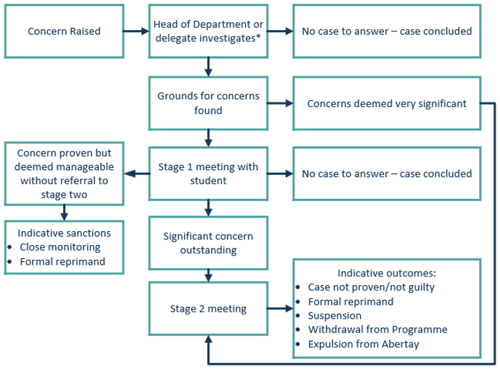
* includes discussions with studentconduct@abertay.ac.uk as to whether the concern raised should be consider under this policy, the Student Code of Discipline: Academic Misconduct or the Student Code of Discipline: Non-Academic Misconduct.
Document Approval Date: 3 June 2026
Effective Date: 1 September 2026
Review Date: 31 August 2027